
FHA vs. Conventional Loans: What's the Difference? | Illinois Homebuyer Guide
"Whatever loan you decide to go with depends on your situation and what you plan on doing in the future." - Jen Corso

🏠FHA vs. Conventional Loans:
What's the Difference and Which One Is Right for You?
If you're thinking about buying a home, one of the biggest decisions you'll make is choosing the right mortgage loan.
Two of the most common options are FHA loans and conventional loans.
While both can help you become a homeowner, they have different requirements, costs, and benefits. Understanding the differences can help you make an informed decision—and potentially save thousands of dollars over the life of your loan.
If you're buying a home in or around Batavia or the greater Chicago suburbs, here's what you should know.
Quick Answer
FHA Loans
Backed by the federal government.
Designed to make homeownership more accessible.
Often a good fit for buyers with lower credit scores or smaller down payments.
Conventional Loans
Not backed by the government.
Offered by private lenders.
May provide lower long-term costs for buyers with strong credit and a larger down payment.
The best loan isn't the same for everyone—it depends on your financial situation and homeownership goals.
What Is an FHA Loan?
An FHA loan is a mortgage insured by the Federal Housing Administration.
Because the loan is government-insured, lenders may be willing to approve borrowers who don't meet the stricter guidelines of some conventional loans.
FHA loans are popular among:
First-time homebuyers
Buyers with limited savings
Buyers rebuilding credit
Buyers who may not qualify for conventional financing
What Is a Conventional Loan?
A conventional loan is a mortgage that isn't insured by the federal government.
Instead, it's offered by banks, credit unions, and mortgage lenders.
Conventional loans often have more flexible property options and can be less expensive over time for qualified borrowers.
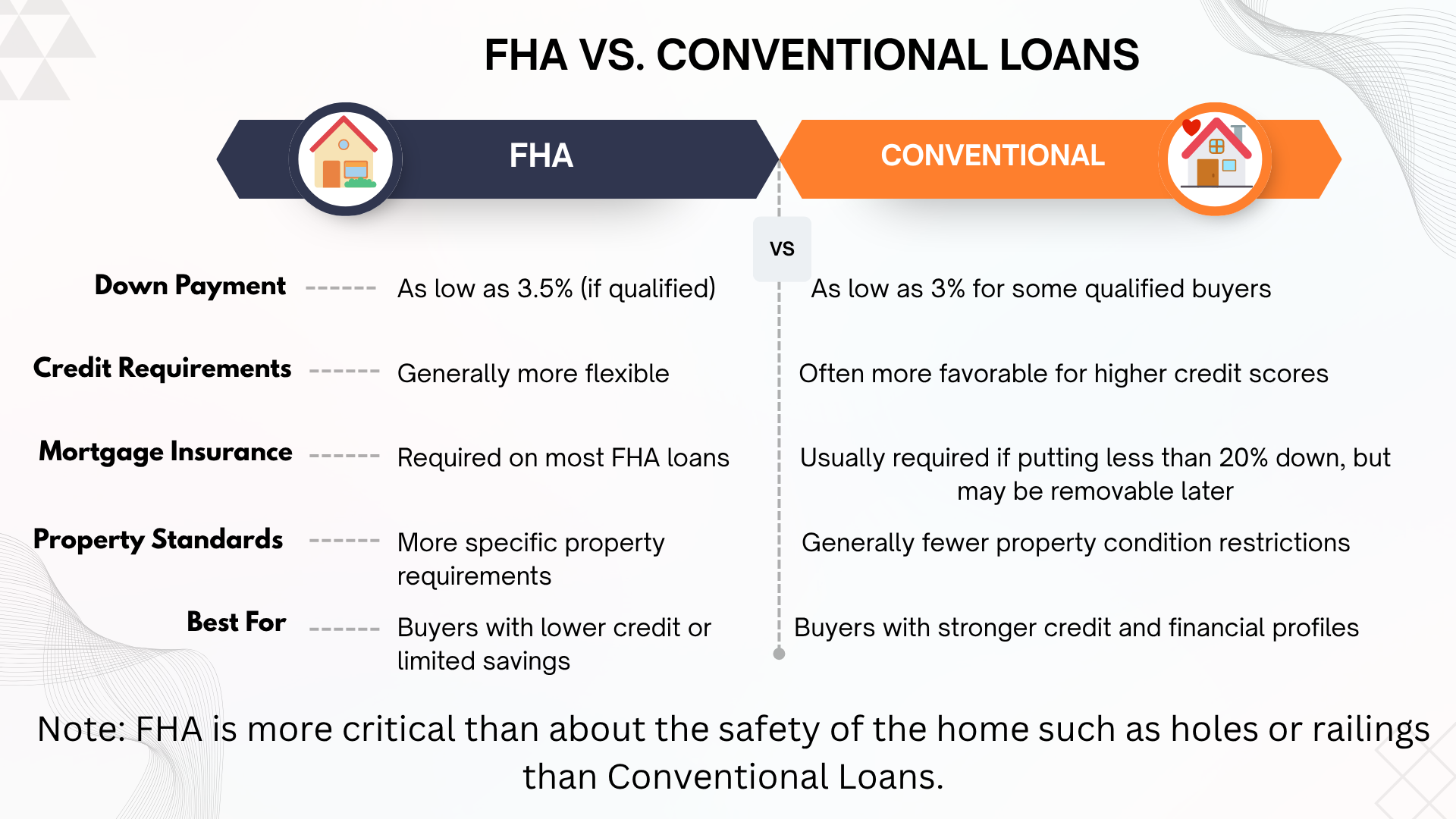
Down Payment Differences
Many buyers believe they need 20% down.
The truth is:
Both FHA and many conventional loan programs allow qualified buyers to purchase a home with much less.
For example:
FHA: as little as 3.5% down for borrowers who meet FHA requirements.
Conventional: some programs allow 3% down for qualified buyers.
Your lender can explain which programs you qualify for.
Credit Score Considerations
Credit scores are one of the biggest factors when choosing between FHA and conventional financing.
Generally speaking:
FHA Loans
May be a good option if:
You're still building your credit.
Your credit score isn't as high as you'd like.
You need more flexible qualifying guidelines.
Conventional Loans
May be a good option if:
You have strong credit.
You're looking for potentially lower monthly costs over time.
You have stable income and manageable debt.
Mortgage Insurance: One of the Biggest Differences
Both loan types may require mortgage insurance if your down payment is below certain thresholds.
However, the way mortgage insurance works is different.
FHA Loans
Most FHA loans require both:
An upfront mortgage insurance premium (which is often financed into the loan), and
An annual mortgage insurance premium paid as part of the monthly payment.
Depending on your down payment and loan terms, FHA mortgage insurance may remain for the life of the loan or for a set period.
Conventional Loans
Private mortgage insurance (PMI) is generally required if you put less than 20% down.
One advantage is that PMI can often be canceled once you meet certain equity and lender requirements.
For many buyers, this can reduce monthly housing costs in the future.
Property Requirements
FHA loans typically require the property to meet certain health and safety standards.
For example, the appraiser may note:
Safety hazards
Peeling lead-based paint (on older homes)
Major structural concerns
Certain repair issues
Conventional loans may offer more flexibility depending on the lender and the property's condition.
Which Buyers Might Benefit Most From an FHA Loan?
An FHA loan may be worth considering if you:
✔ Are buying your first home (though repeat buyers may also qualify)
✔ Have limited savings for a down payment
✔ Are working to improve your credit
✔ Need more flexible qualification guidelines
Example:
Sarah has a good job and has been renting for years. She has saved enough for a modest down payment but is still building her credit after paying off student loans. An FHA loan may provide a path to homeownership that fits her current financial situation.
Which Buyers Might Benefit Most From a Conventional Loan?
A conventional loan may be worth considering if you:
✔ Have a strong credit score
✔ Have stable income
✔ Want the possibility of removing PMI later
✔ Plan to stay in the home for many years
Example:
Mike and Emily have excellent credit, steady income, and savings for a down payment. A conventional loan may offer lower long-term costs and the ability to remove PMI once they build enough equity.
Which Loan Is Better?
The answer depends on you.
There isn't one loan that's best for every buyer.
A mortgage professional can compare:
Monthly payments
Down payment options
Closing costs
Mortgage insurance
Long-term financial goals
Sometimes an FHA loan is the better choice.
Sometimes a conventional loan makes more sense.
The key is comparing your options before making a decision.
Frequently Asked Questions
👉 Can first-time homebuyers get a conventional loan?
Yes. Many first-time buyers qualify for conventional loans, and some programs allow down payments as low as 3% for eligible borrowers.
👉 Do I have to put 20% down?
No.
While putting 20% down eliminates PMI on most conventional loans, many buyers purchase homes with much smaller down payments.
👉 Is an FHA loan only for first-time buyers?
No.
As long as you meet the program's eligibility requirements, repeat buyers may also qualify for FHA financing.
👉 Can I refinance from an FHA loan into a conventional loan later?
Yes.
Many homeowners refinance into a conventional loan if it aligns with their financial goals, such as reducing monthly payments or eliminating mortgage insurance. Whether refinancing makes sense depends on market conditions, interest rates, and your personal financial situation.
👉 Ready to get Pre-Approved? Schedule a 30-Minute Consultation
❤️ Read Blog: "How Much Down Payment Do You Need to Buy a Home?"
The Author is Jennifer Corso - Realtor and Insurance Agent. This article is for educational purposes and based on Jennifer Corso’s professional experience.